

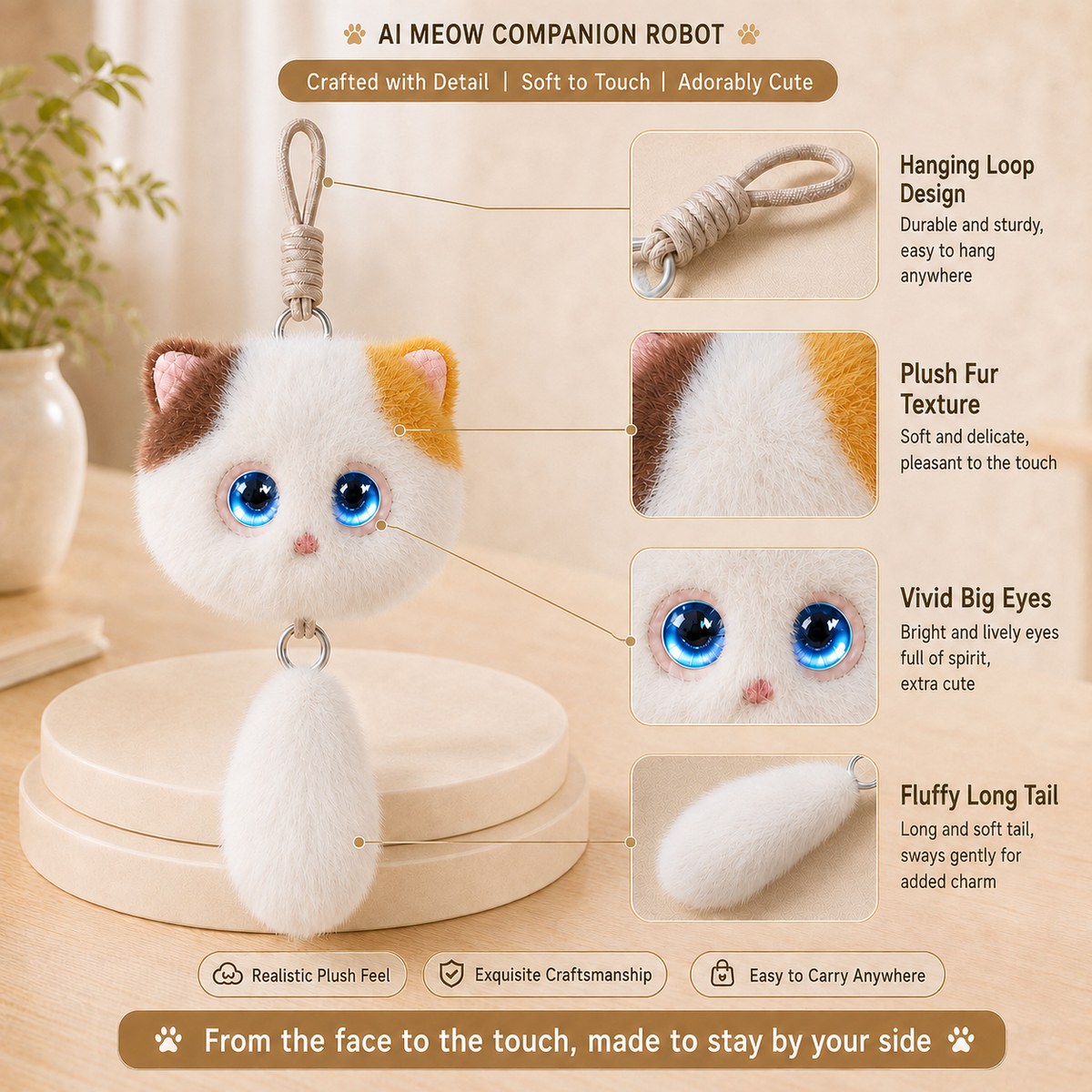
In AI companion plush toys, the eyes do the emotional heavy lifting. Long before a child judges voice quality or conversation logic, they read the face — and AI plush emotion eyes are what turn a talking stuffed animal into something that feels like it is listening. For buyers and brand owners, that makes the eye module one of the most consequential line items on the spec sheet: it shapes perceived intelligence, shelf impact, and the durability story you will have to defend in customer reviews.
Display Options for AI Plush Emotion Eyes
Three display routes dominate the market, each at a different price and positioning tier. The mass-market route is the LED matrix eye screen — animated LED display eyes that blink, wink, and switch expressions in sync with dialogue. This is the workhorse behind most shipping AI plush products: it reads clearly at arm’s length, survives retail price constraints, and keeps power draw modest. Wholesale listings of LED-screen plush lines show typical units around 200 grams with CE-marked builds, which illustrates how commoditized this tier has become.
The mid tier runs on small LCD panels. Lovi’s AI companion, for example, pairs an LCD face with a claimed 20-plus expressions and several character modes, at roughly four to five hours of talk time per charge — a step up in expressiveness that also raises the power and cost budget. The premium route is OLED. ZTE’s Nubia iMoochi, shown at MWC 2026, uses dual OLED-screen eyes with under-screen sensors that adjust brightness to ambient light, plus multiple touch sensors and a six-axis motion sensor, at a price point near US$250. That is a fundamentally different product: a showcase device, not a volume SKU.
One honest caveat for procurement: phrases like “HD LED eye-screen” are marketing language. No vendor we could find publishes resolution, panel dimensions, or supplier part numbers for these modules, so treat display tiers qualitatively — LED matrix as the volume mainstream, OLED as the premium differentiator — and verify competing samples side by side instead of comparing spec sheets line by line.
Animation Range: What the Spec Sheet Should Actually Say
Expression count is the headline number — “20-plus expressions” is the kind of figure brands quote — but buyers should look at how the eyes behave in live conversation. Do they blink at natural intervals? Do they shift from an idle gaze to an attentive look when the child starts speaking? That behavior depends on the rest of the sensing stack: gaze that follows conversation timing needs voice-activity detection plus touch or motion input, the same sensor-fusion architecture of voice, touch, and motion we described in our integration guide.
It is also worth remembering that animated eyes are a positioning choice, not a default. Curio’s Grem and Grok lines ship with permanent embroidered eyes — static, non-animated — at a US$99 price point, and Haivivi’s BubblePal takes a fully screen-free route. Both have found real audiences. The question for your line is not whether emotion eyes are “better” in the abstract, but which face matches your brand story and the price ladder you are building.
When you lock the spec, ask for: the size of the expression library and whether new expressions can be added over the air; blink and gaze behaviors in idle versus conversation states; brightness steps and low-light behavior for bedtime use; and whether the eye-animation pipeline runs on-device or depends on the cloud. That last point matters for latency and for markets with spotty connectivity — offline capability changes what the face can do when the network drops.
Durability and Washability: The Clauses Buyers Forget
Eye screens sit behind fabric or molded lenses, which protects them from curious fingers but complicates cleaning. The industry has converged on a practical answer: the removable core. FoloToy’s Kumma uses a detachable AI module (roughly 55 × 50 × 40 mm) so the plush shell can be washed separately — yet its official care guidance still limits cleaning to hand wash or spot cleaning, with machine washing explicitly off the table. Curio takes a similar route with a zippered back pocket holding a removable voice box, described as making the toy easy to clean. The pattern holds across five or more independent product lines: removable electronics are the de facto standard, and no shipping AI plush we found claims the whole unit is machine-washable.
For your purchase agreement, that means three clauses. First, the electronics core must be user-removable through a simple zipper or pocket, without tools. Second, the care label must match the tested reality — never promise machine washability the module design cannot support. Third, lens and screen surfaces should carry a scratch-resistance expectation verified on your samples, because no vendor publishes standardized drop-test figures for eye modules. Write the incoming-QC test you will actually run, and put the pass criteria in the contract.
Turning Emotion Eyes Into Shelf Impact
On a retail shelf or in a listing thumbnail, the face is the product. Brands that invest in emotion eyes usually pair them with packaging that shows the expressions in action — lenticular cards, QR-linked demo videos, or in-store demo units that wake when handled. Demo strategy matters more here than for static plush: a toy whose eyes are dark on the shelf reads as broken. Plan the demo-unit program, and its battery logistics, alongside the product spec — not after it.
Aslan Technology builds AI companion plush toys as an OEM and ODM partner from our 15,000 m² facility in Chongqing, with 250,000 units of annual capacity, 70,000 units exported each year, and ten years of plush manufacturing experience. If emotion eyes are part of your next line, tell us your target market and expected order volume — we will scope the display tier, the removable-core architecture, and the compliance package (ASTM F963, EN 71, CE/FCC) to your price point.

