

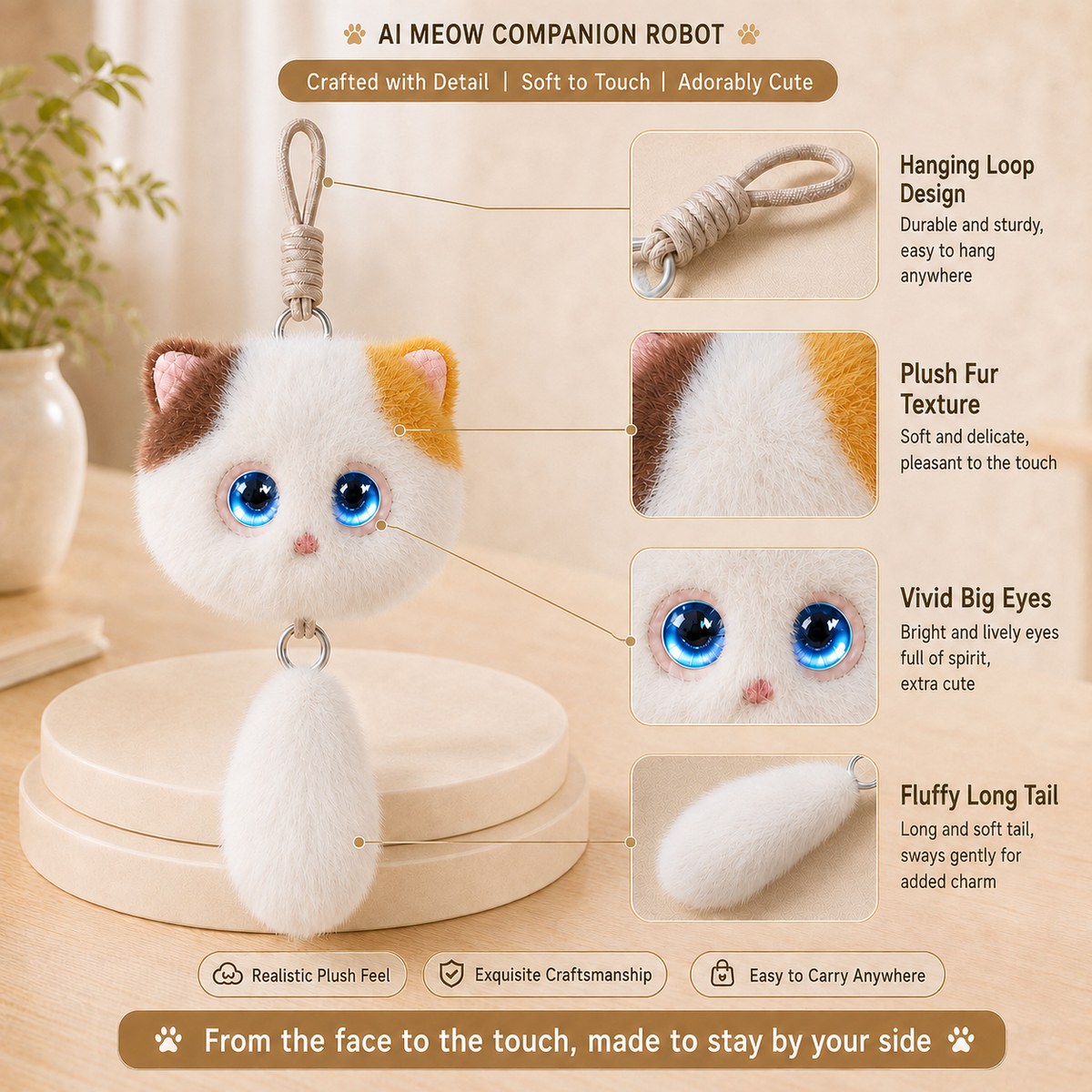
Why does an AI plush toy cost breakdown look so different from a traditional plush toy’s? Because you are not buying a stuffed animal — you are buying a stuffed animal with a computer inside, a cloud service attached, and a certification file thicker than the toy is tall. This article walks through where the cost actually goes, so that when a factory quotes you, the numbers make sense.
Transparency first: exact bill-of-materials percentages are proprietary to each manufacturer, and no public teardown report publishes them for AI plush toys. What follows uses verified industry anchors — published market-report pricing ladders, wholesale module prices, and testing-fee benchmarks — and marks clearly where the numbers come from.
The pricing ladder: from factory floor to retail shelf
A 2026 market report on AI-powered plush and companion toys (Girresearch, via MarketPublishers) sketches the industry’s pricing ladder from public samples: roughly US$36–76 at OEM level and US$79–299 at branded direct-to-consumer level, with branded hardware gross margins targeting roughly 40–60 percent. China’s mass-market AI toys cluster around RMB 300–600 at retail. The same report sizes the global market at US$632 million by 2032, growing at a 19.8 percent CAGR from 2026 — which explains why so many brands are entering now.
Real-world anchors sit comfortably inside that ladder. Wholesale listings show OEM AI toy modules around US$46–51 at 1,000-unit MOQs and AI conversational plush finished goods from about US$56; Haivivi’s BubblePal retrofit module retails at US$89, near the bottom of the branded DTC band. Electronics-industry analysis of smart toys (Sensory Inc., via EE Times) notes a typical 4–5x markup effect: US$5 of technology cost becomes US$20–25 of electronics value at retail before plush, manufacturing, and logistics push the shelf price to US$50–100 or more.
Where the cost goes: the five buckets
An AI plush toy cost breakdown has five buckets. Their relative weight shifts with the product tier, but the buckets themselves are constant across the industry’s upstream supply chain — plush shells and filling, SoC and MCU, wireless modules, batteries, microphones and speakers, touch and motion sensors, AI speech and model software, apps and cloud with OTA, and safety compliance.
- 1. Electronics module (the largest variable). The SoC or MCU, Wi-Fi/Bluetooth module, MEMS microphones, speaker, and sensors are the cost engine. This is also the main lever for tuning a quote: one Chinese AI-toy solution provider’s published case shows its module running 25–35 percent below the industry-average configuration cost, with further savings of about 10 percent from trimming non-core interactions. Every sensor you add and every model upgrade you demand moves this bucket.
- 2. Plush shell and filling. Fabric, embroidery, filling, and cut-and-sew labor. Familiar territory for any plush buyer — and the bucket where mixing colors and styles within MOQ rules directly affects unit economics. Complex character shapes add tooling cost on top; see our guide to AI plush toy sampling cost and timelines for how design complexity flows into price.
- 3. Assembly and integration. AI plush assembly is not traditional plush assembly. The electronic module must be mounted, the microphone ports kept clear of filling, antennas positioned away from metal parts, and the whole unit tested as a system. Integration labor and in-line testing cost more than sewing alone — this is the hidden premium buyers miss when they compare AI plush quotes to ordinary plush quotes.
- 4. Certification and testing. Budget real money here. US CPSIA plus ASTM F963 third-party testing typically runs about US$500–1,800 per product variant, rising to roughly US$1,500–2,500 for products with electronic functions; EU EN 71 packages add hundreds to thousands more, and wireless radio approvals (FCC, RED) add thousands on top (ComplianceGate and industry lab references). These are per-variant costs — amortize them across your order volume when comparing quotes.
- 5. Cloud and software lifecycle. Speech recognition, the language model, speech synthesis, app maintenance, and OTA updates generate costs after the hardware sale. No public per-unit figure exists for this — but the risk is real and documented: when one companion-robot maker’s servers shut down, its US$799 devices stopped working. Ask every supplier who pays for inference, where the servers live, and what happens to the product if the service ends.
Reading a quote like a manufacturer
With the five buckets in mind, a quote becomes legible. A surprisingly low unit price usually means one of three things: a stripped electronics module (fewer sensors, cloud-only processing), an uncertified product (testing costs deferred to you), or missing lifecycle costs (no OTA, no support). A higher price should come with an itemized explanation — which chipset, which certifications are included, what the firmware support term covers.
Three questions cut through any quote:
- Which costs are per-unit and which are per-variant (tooling, testing, certification)? What volume amortizes the fixed costs to your target price?
- What exactly is in the electronics module — and what did you remove to hit this price?
- What are the ongoing costs after delivery — cloud inference, app maintenance, firmware updates — and who bears them for how long?
An AI plush toy cost breakdown is ultimately a trust document. Factories that show their buckets earn the orders; factories that hide behind a single number invite the buyer’s suspicion — or worse, the buyer’s surprise later.
Want an itemized quote for your program? Tell us your target market and expected purchase volume. Aslan Technology is a 15,000 m² AI companion plush toy factory in Chongqing with 10 years of manufacturing experience, 250,000 units of annual capacity, and 70,000 units exported per year. We support OEM and ODM programs with transparent, bucket-by-bucket quotations — so you always know where the cost goes.

